In this article
What to know
- The longer referral produced more weight loss at one year.
- Five-year differences were smaller and statistically uncertain.
- Economic projections are different from measured lifetime outcomes.
Support can help without making an outcome permanent
A longer period of structured support can produce more average weight reduction than a short referral, but the advantage does not necessarily remain equally large years later. WRAP tested that question in adults recruited through primary care in England. [1] Its initial findings favored the longer group program, while the five-year follow-up found smaller differences that were not statistically significant. [2] This is useful evidence for someone deciding how much support to buy. It argues against both extremes: treating a short program as useless, or treating a yearlong membership as a guarantee of permanent results regardless of what happens afterward.
The trial compared referral lengths, not every commercial service
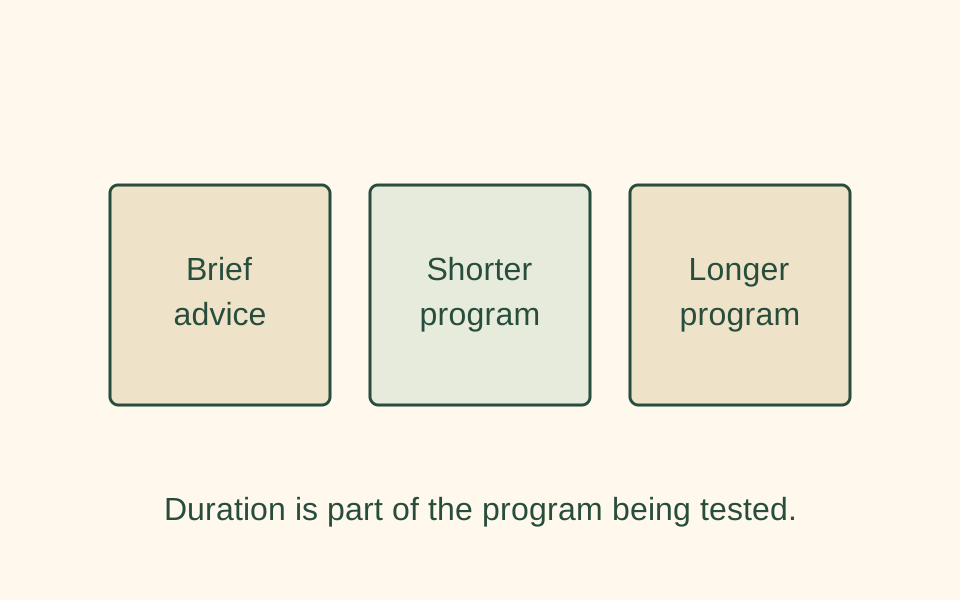
WRAP assigned 1,267 eligible adults to a brief intervention, twelve weeks of an open-group behavioral program or fifty-two weeks of the same program. The commercial provider was Weight Watchers, and the study was not blinded. [1] A protocol specified the main comparisons in advance. [3] This design is more informative than a collection of successful customer stories because it compares assigned groups, including people who do not attend perfectly. It still belongs to a particular program and care setting. It does not establish that every modern app, remote coaching offer or subscription with the word behavioral provides the same intervention.
The one-year advantage was meaningful but not universal
At one year, average weight changes were −3.26 kg after the brief intervention, −4.75 kg after twelve-week referral and −6.76 kg after fifty-two-week referral. The adjusted difference between the longer and shorter programs was −2.14 kg, with a 95% confidence interval from −3.05 to −1.22 kg. No intervention-related adverse events were reported. [1] These averages do not mean that each person lost that amount or that more contact always produces more benefit. They show an advantage of the longer referral under the trial conditions. Attendance, accessibility and the practical value of the sessions still matter to the individual considering a service.
Five-year results need the uncertainty left in
At five years, weight was ascertained for 871 participants, or 69% of the eligible trial population. Mean changes from baseline were −0.46 kg, −1.95 kg and −2.67 kg in the brief, twelve-week and fifty-two-week groups. The adjusted difference between the long program and brief intervention was −1.76 kg, with a confidence interval from −3.68 to +0.17 kg. [2] Because that interval includes no difference, the follow-up does not prove a persisting between-group advantage at the conventional threshold. Some loss remained on average, but a small difference and a certain difference are not the same statement.
For the practical question of support after initial loss, read Structured support for maintaining weight loss.
Economic modeling is not a measured lifetime outcome
The follow-up also modeled future costs and health effects and suggested that referral programs could be cost-saving over longer horizons. [2] That is a projection based on assumptions, not a direct observation of every future disease event or expense. A consumer choosing a current subscription has a different immediate question: what can I afford, what contact will I use and what happens after the included support ends? A favorable modeled public-health result does not establish that the longest commercial package is always the best purchase for one household. Keep the perspective and time horizon attached to any claim about value.
Attendance is part of an offer, not a guarantee
A referral gives someone access to support; it does not ensure that the person can attend or use every part of it. The trial’s comparison of assigned groups is valuable because it preserves that ordinary imperfection rather than describing only the most consistent participants. For a current purchase, the corresponding question is how the program accommodates the life you have. Evening sessions, remote contact or a manageable check-in may matter more than adding months to a package. Ask what happens after an absence and whether the next conversation helps restart the routine. A program should support returning after disruption, rather than making the value depend on never missing a week.
The maintenance plan belongs in the original purchase
A longer program can give someone more opportunities to practice ordinary skills and recover from difficult weeks. The trial does not show that the benefit remains unchanged after support stops. Before paying, consider what the end of the package would look like: continued contact, a lower-cost maintenance option, independent routines or a return to a clinician if needs change. This is not a reason to buy indefinitely. It is a reason to avoid treating the final session as the end of the problem. A useful service helps build a plan that can survive changes in work, budget, health and the availability of support.
Choose enough support to use consistently
When comparing programs, ask about session format, schedule, access and the work expected between contacts. A twelve-week option you can attend may be more useful than a yearlong package that repeatedly clashes with your life. A person who needs individual nutrition care may need a different category altogether. WRAP supports taking sustained help seriously, while the longer follow-up prevents a promise of permanent superiority. The practical goal is a relationship or routine that remains useful through ordinary setbacks. Buy the contact you can use, understand its endpoint and leave room to reassess rather than interpreting a published average as a personal obligation to reproduce it.
If you are comparing support services, see our WeightWatchers review.
Sources
Research describes groups and specific study conditions. Your medical history, symptoms and treatment decisions require advice from your own qualified clinician.