In this article
What to know
- Harder-textured meals can slow eating and reduce intake in controlled experiments. Texture is distinct from processing category and long-term weight change.
- Population, comparison and follow-up determine what the finding can establish.
- A study average is not an individualized outcome prediction.
The food can change the pace
A meal's texture can influence how quickly it is eaten without asking someone to count chews or watch a timer. Controlled experiments suggest that harder-textured meals can slow eating and reduce intake in some settings. That is a different intervention from simply instructing people to eat slowly. It is also a more specific question than declaring all processed foods equivalent. Researchers have tried to separate texture, energy density and processing category to understand what drives the immediate response. The useful takeaway is that food structure matters, while a short experiment does not establish a universal weight-loss rule or make softer food inherently bad.[1] [2] [3]
For the related decision, read the connected evidence.
A four-meal experiment separated two factors
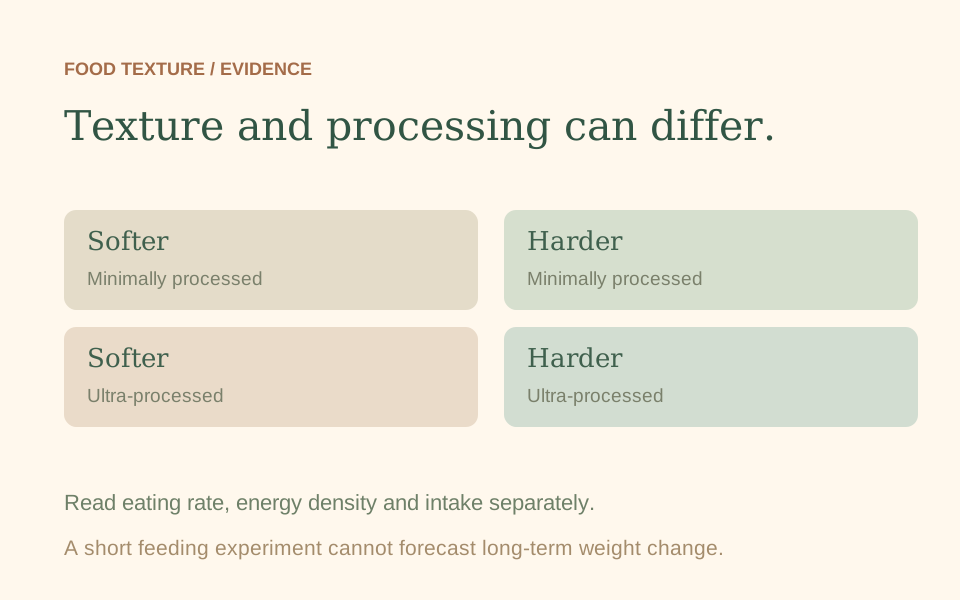
Teo and colleagues studied 50 healthy-weight adults in a randomized crossover design. Participants ate meals combining harder or softer texture with minimally processed or ultra-processed components. The harder meals were consumed more slowly and produced lower food and energy intake overall. This design helps test whether texture contributes beyond the processing label. It also has limits: the meals were specific combinations, and energy density was not perfectly identical across every condition. A consumer summary should retain those details instead of treating the result as proof that a classification label never matters or that hardness alone explains every difference.[1]
A daily-diet experiment extended the question
A 2023 randomized crossover study by Lasschuijt and colleagues included 18 healthy adults and offered harder or softer diets across processing categories. The diets were matched in energy density, making the texture question more focused. Daily energy intake was lower under the harder-texture conditions, while processing level did not show a clear effect on intake in that small experiment. That is useful evidence about the tested diets. It does not overturn all research on ultra-processed eating or establish that every product within a category behaves alike. The small sample and controlled setting are part of the result, not details to omit after an attractive headline.[2]
Earlier work checked later compensation
An earlier randomized meal study by Bolhuis and colleagues compared harder and softer foods and then examined intake later in the day. It reported less energy consumed at the harder lunch without a compensating increase at the later meal measured. That extends the question beyond a single plate, which is helpful. It still does not establish what happens across weeks or months. A response that persists through an evening is not automatically a permanent change in energy balance. The study supports examining the whole day's intake rather than assuming a smaller lunch either must or cannot be offset later.[3]
For the related decision, read our support-model comparison.
Texture and energy density can interact
Eating rate in grams per minute and energy intake rate in calories per minute are different measures. A meal can be eaten slowly by weight while still delivering substantial energy if each gram is energy dense. Conversely, a relatively quick-eating food may have a low energy density. That is why matching or measuring energy density matters in texture experiments. A consumer should not reduce the finding to chewiness alone. The relevant meal includes its structure, portion, composition and how it is served. The experiments isolate particular combinations so researchers can study them; ordinary eating contains more variation than a simple hard-versus-soft category can capture.[1] [2]
This is different from a willpower instruction
The texture studies manipulate the meal rather than asking everyone to follow the same behavioral instruction. That distinction may make the idea more interesting for product design and practical meal planning. It does not establish that a person who eats quickly is doing something wrong. A meal may be soft because of preference, culture, dental health, swallowing needs or convenience. Those circumstances matter more than turning a laboratory result into a moral rule. Our separate eating-speed article examines instructions and chewing experiments, including null findings. The two questions are related, but evidence for one should not be presented as if it directly tested the other.
The population limits are substantial
The controlled studies discussed here mainly involved relatively young, healthy participants, with small samples and specific foods. They do not establish the same response in older adults, people with dental difficulties or those needing a medically modified texture. For some people, making food harder could be inappropriate or unsafe. That is not an obscure exception to be brushed aside in a weight-management tip. A meal should remain comfortable and suitable for the person eating it. If a swallowing or chewing concern is present, obtain individualized advice rather than using a harder-food challenge as an intake-control strategy.[1] [2] [3]
For the related decision, read our Prospre review.
Do not calculate a year’s fat loss from a laboratory day
The experiments measure intake over meals or short periods. They do not prove that a particular texture change produces a sustained calorie deficit or a specified body-weight change. Appetite, food choices and adherence can change over time, and the longer routine has to remain acceptable. Multiplying an acute difference across every day of the year would assume all those uncertain pieces stay fixed. That is exactly what a longer free-living trial would need to test. A useful consumer conclusion can remain modest: texture is a plausible influence on pace and intake, with longer-term outcomes still requiring separate evidence.[1] [2] [3]
A practical application can stay flexible
For someone without texture-related clinical needs, the evidence may prompt attention to whether meals are satisfying and comfortable to eat at an unhurried pace. That is an application, not a proven individual prescription. Consider preparation time, cost and enjoyment alongside any interest in food structure. There is no reason to replace all soups, yogurt or other soft foods merely because harder test meals reduced intake in a study. A varied, adequate eating pattern cannot be judged by one physical property. If meal planning is the difficult part, a useful service should help assemble workable meals rather than sell a universal rule about texture.
The conclusion worth keeping
Food texture can influence eating behavior, and randomized experiments show that harder meals can reduce intake in defined settings. The strongest interpretation respects the design: texture, processing category and energy density are related but distinct features, and short-term intake is not long-term weight change. This evidence helps explain why foods with similar labels may be experienced differently. It does not establish a single best diet or justify ignoring clinical texture requirements. Use it to think more carefully about the meal itself and the routine around it, while judging any commercial weight-loss claim by the outcome and duration actually studied.[1] [2] [3]
Sources
- Teo et al. Texture-based differences in eating rate and energy intake randomized crossover study (2022) (opens in a new tab)
- Lasschuijt et al. Speed limits randomized crossover dietary intervention (2023) (opens in a new tab)
- Bolhuis et al. Slow Food randomized harder-food study (2014) (opens in a new tab)
Research describes groups and specific study conditions. Your medical history, symptoms and treatment decisions require advice from your own qualified clinician.