In this article
What to know
- RE-POWER compared three delivery models in rural primary care. In-person groups had a modest weight advantage; access and satisfaction also mattered.
- Population, comparison and follow-up determine what the finding can establish.
- A study average is not an individualized outcome prediction.
The delivery model was the experiment
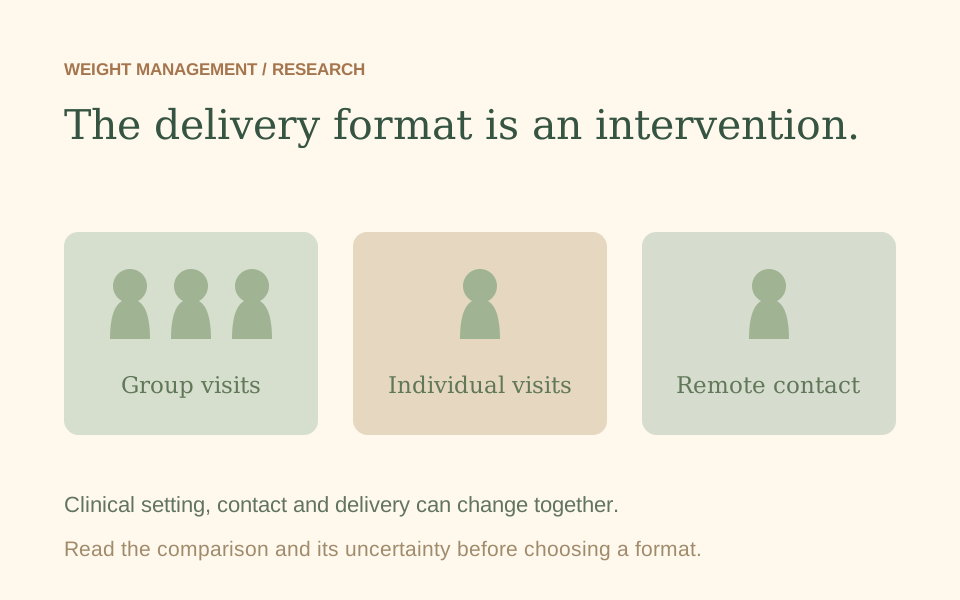
RE-POWER tested how behavioral weight-management support could be delivered through rural primary care. The three options were individual clinic visits, group clinic visits and telephone group visits. In-person groups produced a statistically clearer average weight advantage over individual visits at 24 months, but the difference was small and its clinical importance uncertain. Telephone groups did not establish the same superiority. That is more informative than saying group treatment always wins. The trial helps separate the format of support from the content being delivered, while showing why convenience, continuity and the experience of care still belong in a consumer comparison.[1]
For the related decision, read the connected evidence.
Clinics were randomized, not every patient independently
The study involved 36 rural primary-care practices and 1,407 eligible adults with obesity. Practices were assigned to one of the three delivery models, with participants receiving care through their assigned practice. This cluster design fits a service-delivery question: a clinic can organize a program consistently rather than running every format independently for every person. It also means the analysis must account for people sharing a clinic. Treating the data as though all participants were completely independent would miss that design feature. The result concerns implemented clinic models, not a simple preference survey in which individuals freely selected their favorite format.[1] [2]
All three groups received active support
The individual-visit comparison was an active behavioral approach modeled on intensive obesity counseling, not a group left without help. The alternatives changed how that support was delivered. This matters because a modest difference between active programs does not mean either program had no value. A consumer deciding between options should compare the actual intensity, professional input and follow-up rather than assume that the word individual or group defines the complete service. A private appointment every few months is not automatically equivalent to the trial's individual model, just as an informal online group is not automatically its structured group intervention.[1] [2]
The primary difference needs perspective
The reported 24-month average changes were about −4.4 kg for clinic groups, −3.9 kg for telephone groups and −2.6 kg for individual clinic visits. The clinic-group contrast with individual visits met the study's significance criterion; the telephone-group contrast did not. The authors also reported no statistically clear between-group difference in the proportion losing more than 5% of starting weight. That combination limits a sweeping claim about clinical superiority. An average difference can be statistically detectable while still modest in practical size. It should not be turned into a promise of a large additional loss from simply switching appointment formats.[1]
For the related decision, read our support-model comparison.
Attendance and weight did not move as a single score
The main report describes higher attendance in the individual-visit arm, particularly later in treatment, despite its smaller average weight reduction. That is a useful reminder that engagement and outcome are related but distinct. A program's attendance rate does not automatically prove that it produces the strongest weight result, and a favorable weight average does not show that every participant found the format easy to sustain. A buyer should ask both questions. Can the schedule be maintained, and does the service provide the kind of useful support sought? One headline cannot settle the entire decision.[1]
Patient experience adds another dimension
A related mixed-methods analysis examined satisfaction and care experiences in the same trial. Telephone-group participants reported lower satisfaction than those receiving face-to-face counseling across the measured domains at six months and most domains at 24 months. Interviews emphasized meaningful interaction with primary-care clinicians. These observations help explain why a convenient remote format might still feel less connected for some participants. They do not establish that telephone support is unsuitable for everyone or that current video programs would produce the same ratings. The paper describes the formats, people and communication arrangements actually used in RE-POWER.[3]
Convenience has to be evaluated in context
A telephone group can remove travel and may create access where another service is impractical. An in-person group may offer a different type of interaction but require a fixed time, transport and comfort discussing a topic with others. Individual visits can provide privacy and scheduling flexibility. The trial does not make those tradeoffs disappear. Instead, it gives a reason to ask how the care will fit an actual week. Someone who cannot attend the apparently stronger average option may be better served by an accessible, appropriate alternative than by choosing a theoretical winner they rarely use.
For the related decision, read our Working Against Gravity review.
The population was not every possible consumer
Participants came from rural practices in the study region, and the sample was predominantly women and White non-Hispanic adults. Those characteristics affect how widely the results can be generalized. A program serving a different community, providing a different language or using contemporary digital tools needs its own evaluation. Nor was this a medication comparison or a test of every commercial coaching app. The findings are useful for understanding a real primary-care delivery question. They should not be used as a blanket statement that all group services outperform all individual dietitians or that an inexpensive online forum reproduces a clinical intervention.[1] [2]
Questions worth asking a program
Ask who leads the sessions, what training they have, how often contact occurs and whether the same professional follows the member over time. For a group, ask its size, privacy expectations and options when a session is missed. For remote care, ask whether the support is telephone, video or asynchronous messaging, because those are different experiences. These are editorial applications of the delivery-model evidence rather than a checklist proven to guarantee weight loss. The aim is to identify a service that can deliver its promised support under the member's actual circumstances, with a clear route to individualized clinical advice when needed.
The conclusion worth keeping
RE-POWER supports taking the structure of care seriously. Clinic groups showed a modest average weight advantage over individual visits, while telephone groups did not establish the same benefit and received lower satisfaction ratings in the related analysis. Those results help inform a choice; they do not determine it for every person. Compare the actual service, professional relationship, schedule and cost rather than buying a format label. A program that is accessible and appropriate can be useful even if it is not the average winner in one trial. The evidence is strongest when its setting and limits stay visible alongside the result.[1] [2] [3]
Sources
Research describes groups and specific study conditions. Your medical history, symptoms and treatment decisions require advice from your own qualified clinician.