In this article
What to know
- SWAP-MEAT tested supplied substitutes in a small short crossover trial.
- Its weight finding was secondary and is not a long-term forecast.
- Later randomized evidence does not support a universal benefit for all plant meats.
A plant label does not settle a weight question
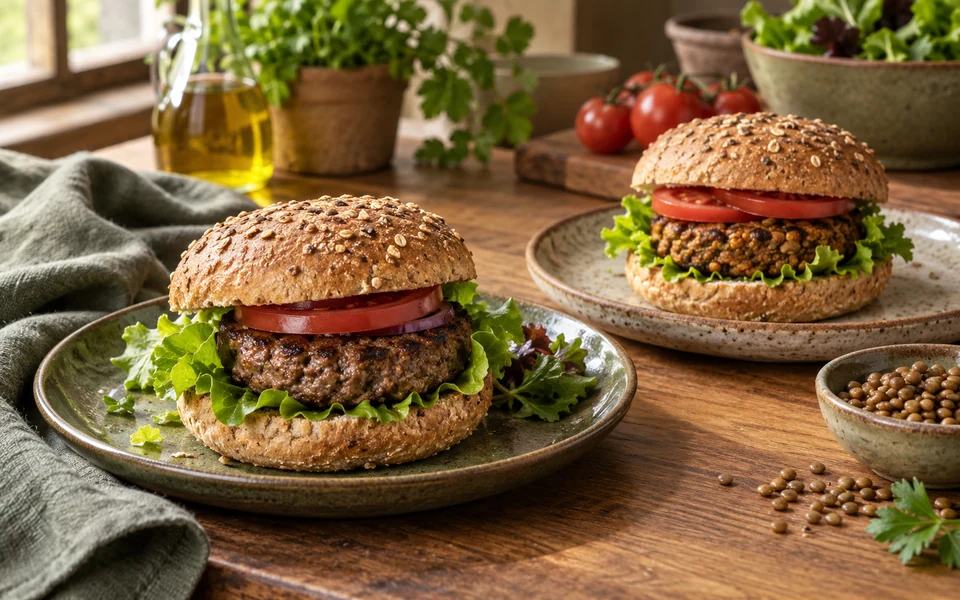
A plant-based burger can make a familiar meal easier to adapt, but the label alone cannot predict what happens to weight or health. SWAP-MEAT tested a specific substitution: supplied plant-based meat alternatives instead of animal meats, while participants tried to keep the rest of their eating similar. [1] That is more useful than treating every plant product as one nutritional category. It also differs from replacing meat with beans, lentils or an entirely different dietary pattern. For an ordinary meal decision, the question is what the new food replaces and whether the whole meal still works for appetite, preferences and practical cost.
The trial was a small crossover experiment
Participants completed eight weeks of plant alternatives and eight weeks of animal meat in randomized order, without a washout period. Thirty-six provided complete data for both phases. They were asked to eat at least two daily servings of the assigned foods, with similar reported servings across phases. [1] A crossover allows each person to contribute to both comparisons, but the order and potential carryover still matter. This was a short, supported food experiment in generally healthy adults. It was not a long-term weight-management program or a test of every brand in a supermarket. Those boundaries should travel with any claim taken from it.
Weight was not the primary outcome
Average weight during the plant phase was 78.7 kg versus 79.6 kg during the animal phase. LDL cholesterol was also lower, while the primary outcome was a blood biomarker called TMAO; its results showed an order effect. [1] The weight difference is about 0.9 kg in this comparison. It should not become a monthly forecast or a promise of steady continued loss. TMAO is a measured biomarker, not a count of heart attacks prevented. A consumer-facing explanation needs to keep the scale result modest and the main research question accurate, rather than combine every favorable measurement into a broad claim that the food prevents disease.
A later trial did not reproduce a universal advantage
A separate Singapore trial randomized 89 adults at elevated diabetes risk to eight weeks of plant meat analogs or corresponding animal meats; 82 participants were included in the reported analysis. LDL cholesterol was the primary outcome and did not show a significant between-diet effect. The authors did not find widespread cardiometabolic benefits from the plant-meat diet. [2] This does not prove all alternatives are ineffective. It shows why the product formulations, population and comparator matter. A finding from one food substitution should not be stretched into a rule for an entire category, particularly when another randomized experiment gives a less favorable overall picture.
The inflammation claim also needs restraint
A secondary analysis of SWAP-MEAT examined 92 inflammatory biomarkers. Only four reached statistical significance, and the overall findings did not support the expected relative improvement in inflammation. [3] It was an analysis of the same trial participants, not independent confirmation of a broad anti-inflammatory effect. For a shopper, that distinction limits another appealing claim. A product can be a useful ingredient without being an inflammation treatment. The more persuasive article would explain its ingredients and nutritional role rather than borrow an attractive biological phrase. When a meal service uses research language, look for the actual endpoint and whether the evidence comes from its own food or a different product category.
Support can change what a substitution achieves
RE-MAP tested a broader behavioral intervention: four weeks of free meat substitutes together with information, recipes and examples of eating less meat. Among 115 randomized adults, the intervention reduced meat consumption compared with control at four weeks, with a smaller difference still present at eight weeks. [4] Its primary outcome was meat intake, not sustained weight loss. That distinction is helpful because convenience and instruction can make a change easier even when the trial does not establish the health outcome someone ultimately wants. A meal kit may solve planning; a prepared meal may solve time. Neither service needs a borrowed weight-loss promise to have practical value.
Compare the actual meal rather than a category
The Singapore trial reported differences in fiber, sodium and other dietary components between groups, alongside the absence of widespread benefit. [2] That makes the nutritional details worth reading rather than assuming the word plant settles them. A sensible comparison considers the full serving, protein, fiber, sodium and the foods that complete the plate. It also considers whether you enjoy the meal enough to keep it in a normal routine. There is no need to force every choice into a perfect-food contest. A replacement can be useful because it makes a workable pattern easier, while still having tradeoffs that deserve attention.
For the separate question of processing and intake, read our food processing and weight evidence.
Use the research to make one workable swap
SWAP-MEAT supplies an interesting short-term result, not a complete prescription for weight management. The stronger practical approach is to compare a specific familiar meal with a specific alternative, then consider the whole dietary pattern and the support needed to sustain it. If a plant-focused meal subscription helps, judge its menu, portions and recurring cost directly. If the bigger problem is planning adequate meals or managing a health condition, a dietitian may offer a different kind of help. The research can make those choices more informed without dictating a single correct shopping basket. Keep the claim as concrete as the food being substituted, and allow convenience and enjoyment to count alongside nutrition.
For a plant-focused meal service, compare our Purple Carrot review.
Sources
Research describes groups and specific study conditions. Your medical history, symptoms and treatment decisions require advice from your own qualified clinician.