In this article
What to know
- SNAP tested structured self-regulation in young adults, not a universal tiny-habits cure. Larger periodic changes outperformed its small-change approach.
- Population, comparison and follow-up determine what the finding can establish.
- A study average is not an individualized outcome prediction.
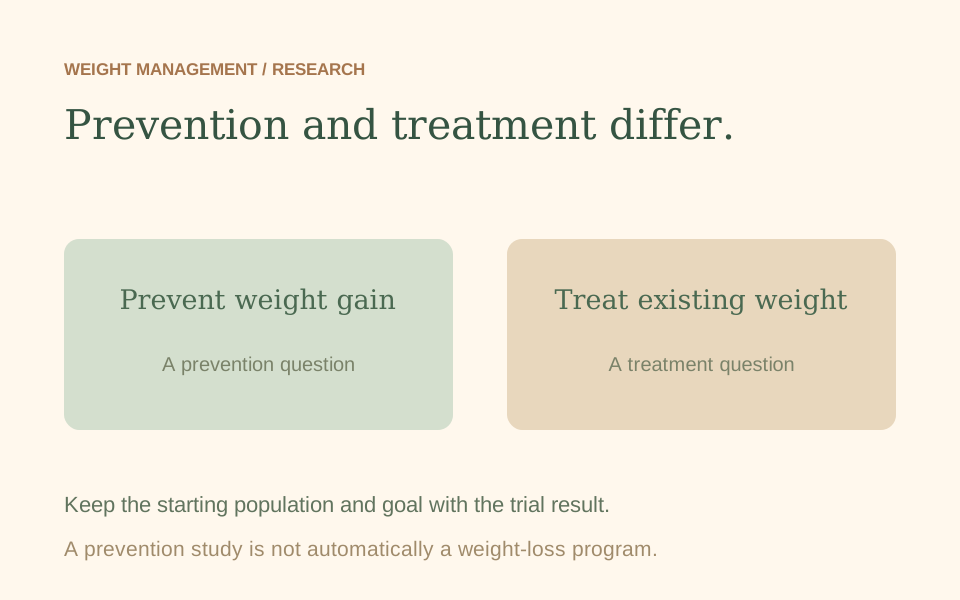
Prevention was the target
The Study of Novel Approaches to Weight Gain Prevention, or SNAP, asked whether structured self-regulation could help young adults avoid gaining weight. That question differs from treating established obesity or maintaining a large previous loss. Both its small-change and large-change programs performed better than a minimal intervention over the main follow-up, with the large-change approach producing the stronger average weight result. The important qualifier is that small changes were delivered as part of a supported program. This was not a test of an isolated tip, and it does not prove that any tiny habit will prevent weight gain in any population.[1] [2]
For the related decision, read the connected evidence.
The participants and comparison define the claim
SNAP randomized 599 adults aged 18 to 35 to a minimal intervention, a small-change program or a large-change program. The enrolled group had an average BMI around 25, and about half were in the normal-weight range. That starting point matters when interpreting the result. A prevention program in relatively young adults should not be used to promise the same response in people with different health needs or longstanding obesity. The study also required participants to be able to engage with the program. A positive result among people who enter a structured trial is useful evidence, but it does not establish universal reach.[1] [2]
Both programs used self-regulation
The interventions shared frequent weighing, feedback and behavioral support. Small Changes emphasized modest, consistent adjustments to eating and activity. Large Changes emphasized an initial weight-loss buffer intended to protect against expected later gain. The published protocol describes repeated group sessions and later refresher support. These were packages, not simply competing slogans. It would be inaccurate to attribute the entire result to a small calorie adjustment or a scale alone. Someone borrowing an idea from the trial should recognize that contact, monitoring and opportunities to respond to changes were also part of the design.[1] [2]
The weight findings were averages across follow-up
Over a mean follow-up of about three years, reported mean weight changes were approximately +0.26 kg in control, −0.56 kg with Small Changes and −2.37 kg with Large Changes. The comparisons favored both active programs over control and Large Changes over Small Changes. These figures describe the trial's averaged follow-up outcome, not a guaranteed final measurement for every participant. They also do not establish that the smallest possible change is always best because it is easier. The more substantial structured approach did better on the primary weight question in this population, while still leaving individual variation and practical acceptability to consider.[1]
For the related decision, read our support-model comparison.
Why the dietary follow-up adds a useful limit
A subsequent analysis examined reported dietary outcomes within SNAP. The intervention groups reported greater reductions in energy intake than control at four months, but not at two years, and the analysis did not find between-group differences in overall diet quality. Associations between reported eating changes and weight change were also examined. Those associations do not become randomized proof of each individual food behavior. The paper helps show that an intervention's weight result and every proposed dietary mechanism are not interchangeable. A program can affect the primary outcome without confirming every simple explanation attached to its name.[3]
The result does not make weighing mandatory for everyone
Frequent weighing served as a feedback tool within these interventions. That does not establish that it is appropriate for every reader, especially when weight monitoring causes distress or conflicts with an individualized care plan. SNAP also excluded people with an eating-disorder history in its eligibility framework. Consumer advice should retain that boundary rather than presenting the study's monitoring routine as a moral obligation. A qualified professional can help determine whether weight feedback, another measure or a different approach is suitable. The trial identifies what its investigators tested; it does not remove the need to consider how a routine affects the person using it.[2]
Another trial cautions against a universal small-change promise
A separate randomized trial in 320 sedentary adults with overweight or obesity compared a small-change approach with monitoring alone. Its report did not support the small-change approach as more effective for long-term weight-gain prevention in that setting. The population and program differed from SNAP, so this is not a direct repeat of the same protocol. It is nevertheless an important counterweight to claims that small changes reliably work regardless of age, baseline condition or support. The sensible synthesis is conditional: some structured prevention approaches can help, but the intervention and the people studied matter.[4]
For the related decision, read our Nourish review.
Do not confuse a manageable step with a proven treatment
A manageable change can be worthwhile because it is easier to fit into daily life. That practical appeal does not guarantee a particular biological outcome or show that it is sufficient for a person's needs. If a commercial program cites SNAP, ask whether its service resembles the supported self-regulation package, whether it is targeting prevention or treatment, and which result it claims to reproduce. An app reminder is not automatically the equivalent of repeated group sessions and clinical research follow-up. Conversely, a service need not reproduce SNAP to be useful; it should simply describe its own value without borrowing an unsupported guarantee.
What a household can take from the design
The broader lesson is the value of a feedback loop: choose a feasible action, decide what would show whether it is helpful and review the routine when circumstances change. That is an editorial application of the study, not a personal weight-loss prescription. For one household, the relevant problem may be shopping; for another, access to individual nutrition advice or an activity routine. The trial does not dictate one answer. It does suggest that a plan's ongoing support and adjustment deserve as much attention as its opening promise. Compare the actual work required with what can be sustained, including during holidays, illness or a changing schedule.
The conclusion worth keeping
SNAP provides randomized evidence that two structured self-regulation programs reduced weight gain relative to minimal intervention in young adults, with the larger-change approach performing better on the main weight outcome. It does not establish that small changes alone treat every weight problem or that a particular tracking routine is suitable for everyone. The dietary follow-up and the separate small-change trial make the limits clearer. Use SNAP to evaluate the purpose, population and support behind a claim. A practical step can be useful without being a universal solution, and a person needing more intensive care should not read a prevention trial as evidence that they have failed to make small changes correctly.[1] [3] [4]
Sources
- Wing et al. SNAP randomized clinical trial (2016) (opens in a new tab)
- NHLBI BioLINCC SNAP study design, population and intervention record (opens in a new tab)
- LaRose et al. SNAP dietary outcomes (2019) (opens in a new tab)
- Ross et al. Small-change weight-gain prevention randomized trial (2022) (opens in a new tab)
Research describes groups and specific study conditions. Your medical history, symptoms and treatment decisions require advice from your own qualified clinician.