In this article
What to know
- A supported behavioral program reduced weekly leakage more than structured education at six months.
- The evidence was clearer for stress leakage than urgency leakage.
- Symptom improvement can matter alongside weight, while persistent symptoms still deserve care.
A daily-life outcome beyond the scale
Fewer episodes of bladder leakage can matter more than a particular clothing size. In the PRIDE randomized trial, women assigned to an intensive behavioral weight-loss program had a larger reduction in weekly urinary-incontinence episodes than women assigned to structured education. [1] That is a useful clinical benefit to discuss. It is also more specific than saying weight loss fixes bladder problems. The trial studied women with frequent leakage, and the strength of the result differed by symptom type.
This evidence can make progress easier to describe without turning weight into a requirement for deserving care. Someone can pursue support for leakage and discuss a workable weight-management program at the same time. PRIDE does not establish that bladder assessment should wait until a weight goal has been reached, or that an unsuccessful attempt at weight loss closes off other treatment options.
Who and what the trial actually compared
PRIDE randomized 338 women with overweight or obesity and at least ten urinary-incontinence episodes per week. The intensive group included 226 women; 112 entered structured education. The initial intervention lasted six months and combined diet, physical activity and behavioral support. Both groups received a booklet about behavioral management of incontinence. [1] [2] The comparator therefore was not simply being ignored or offered no information.
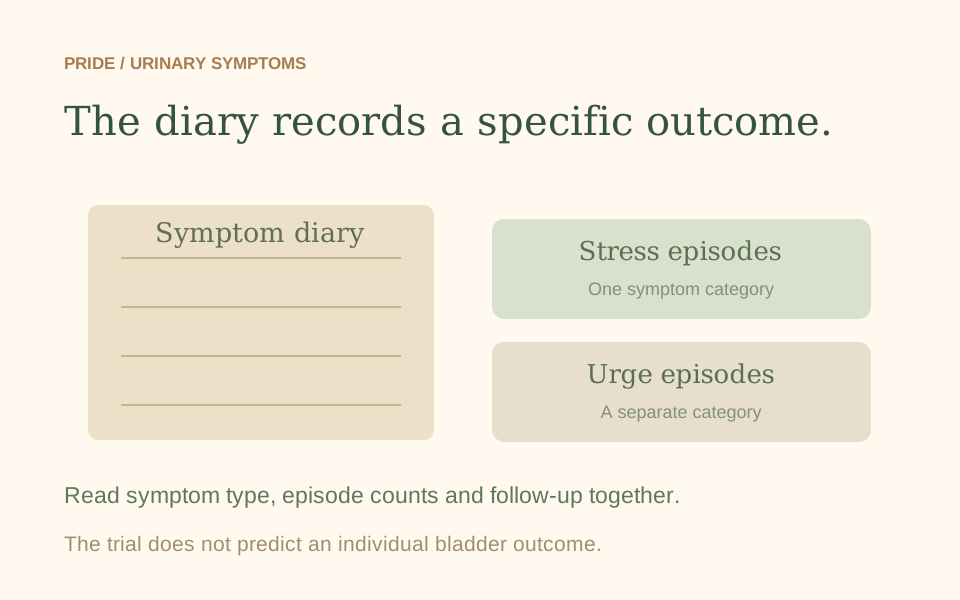
A seven-day diary recorded leakage episodes. That measure connects the study to ordinary life, though it still depends on participants recognizing and recording symptoms. The treatment was a package delivered with support. The trial cannot attribute every improvement to the number of kilograms lost, isolate exercise from dietary change, or establish that downloading an app reproduces the same program and contact.
What improved at six months
Average weight reduction was approximately 8.0% in the intensive group and 1.6% with education. Weekly incontinence episodes declined by about 47% and 28%, respectively. [1] Those are percentage reductions from each group's starting episode frequency. They do not mean 47% of participants were cured, and subtracting them does not produce a 19% chance that a particular woman will become continent.
Both groups improved, which is important for interpretation. Comparing the intensive group's before-and-after change alone would give the whole program credit for changes also seen with education and time. The randomized between-group result is the more useful estimate of the program's added benefit. Even that estimate describes an average effect among trial participants rather than the response of every woman who joins a modern commercial program.
Stress and urgency leakage should not be merged
The main trial found a clearer between-group reduction for stress-incontinence episodes than for urge-incontinence episodes. [1] Stress leakage refers to leakage associated with physical pressure or exertion; urgency leakage accompanies a sudden compelling need to urinate. People can have both. Keeping the categories visible helps prevent an average result across all episodes from becoming a confident claim about every symptom.
A secondary PRIDE analysis also explored urinary symptoms beyond leakage, including frequency, urgency and nighttime urination. It did not find a clear added benefit of the weight-loss intervention across those outcomes compared with control. [3] That does not erase the leakage result. It limits its reach. A program that helps one measured symptom should not automatically be promoted as a solution for the whole range of bladder complaints.
A plausible mechanism is not the same as a treatment effect
A PRIDE urodynamic substudy assessed pressure and bladder measurements in a subset of participants. Associations between body size and abdominal pressure offered a possible explanation for the link between obesity and leakage. [4] These were physiological associations. They cannot establish that a particular change in waist size will produce a predictable reduction in leakage for an individual.
This distinction is useful when explanations sound reassuringly mechanical. Bodies are more complicated than a simple pressure gauge. The randomized trial addresses whether assignment to the supported program improved symptoms on average; the substudy investigates one possible reason. Neither supplies a diagnostic test that someone can perform at home by measuring their waist, and neither proves that body size is the only cause of their symptoms.
Modest loss is an association, not a required threshold
A later analysis of PRIDE followed weight change and symptoms through 18 months. Losing roughly 5% to 10% of starting weight was associated with meaningful improvements in leakage and satisfaction. [5] Participants were not randomized to lose exactly those amounts. People who maintained different degrees of weight loss may also have differed in activity, engagement, health or other factors.
It is reasonable to discuss a feasible amount of change rather than assuming benefit requires a dramatic transformation. It is less reasonable to treat a category boundary as a biological switch. The findings do not mean that losing just below a threshold is useless or that losing beyond it guarantees continence. They also do not tell someone to keep restricting food until every symptom disappears. Symptoms and the effort required to manage weight deserve their own follow-up.
For other outcomes that can matter alongside weight, read progress beyond body weight.
Compare the program with the week you can sustain
The intensive intervention involved more than being told to eat less. Its protocol supplied a structured behavioral program and a maintenance phase. [2] In an ordinary week, that translates into practical questions about appointments, meal routines, activity that feels manageable, and the kind of support that helps rather than overwhelms. A service should be judged on whether it can deliver that support, not merely whether it uses the phrase lifestyle change.
The cost of a commercial program is a separate question from whether the study intervention helped. A meal planner organizes meals; a dietitian can individualize nutrition care; a clinician can assess urinary symptoms. Those purchases serve different purposes. It would be misleading to treat an inexpensive food diary as a tested treatment for incontinence because both a diary and the research program involve paying attention to food.
For individualized nutrition support, consider the service scope in our Fay dietitian-care review.
Let the symptom be part of the care conversation
PRIDE gives women with overweight or obesity and frequent leakage a reason to discuss supported weight management as one component of care. Its strongest everyday message is that an outcome beyond the scale can count. A diary showing fewer leaks may capture a meaningful change even when weight loss is modest, while persistent symptoms remain worth addressing.
The evidence does not make leakage a personal failure or supply a universal cure. Bring the symptom pattern, its effect on daily activity and the support you can realistically use to a clinical discussion. The goal is a workable combination of care and habits. Weight change is one possible part of that combination, rather than the price of entry to being heard about an uncomfortable and disruptive problem.
Choose the kind of support using our dietitian, training and tracking comparison.
Sources
- PRIDE randomized trial: Weight Loss to Treat Urinary Incontinence in Overweight and Obese Women (opens in a new tab)
- PRIDE original protocol and operations manual (opens in a new tab)
- Original PRIDE secondary analysis of nonincontinence lower urinary tract symptoms (opens in a new tab)
- Original PRIDE urodynamic substudy (opens in a new tab)
- Original PRIDE analysis: Improving Urinary Incontinence Through Modest Weight Loss (opens in a new tab)
Research describes groups and specific study conditions. Your medical history, symptoms and treatment decisions require advice from your own qualified clinician.