In this article
What to know
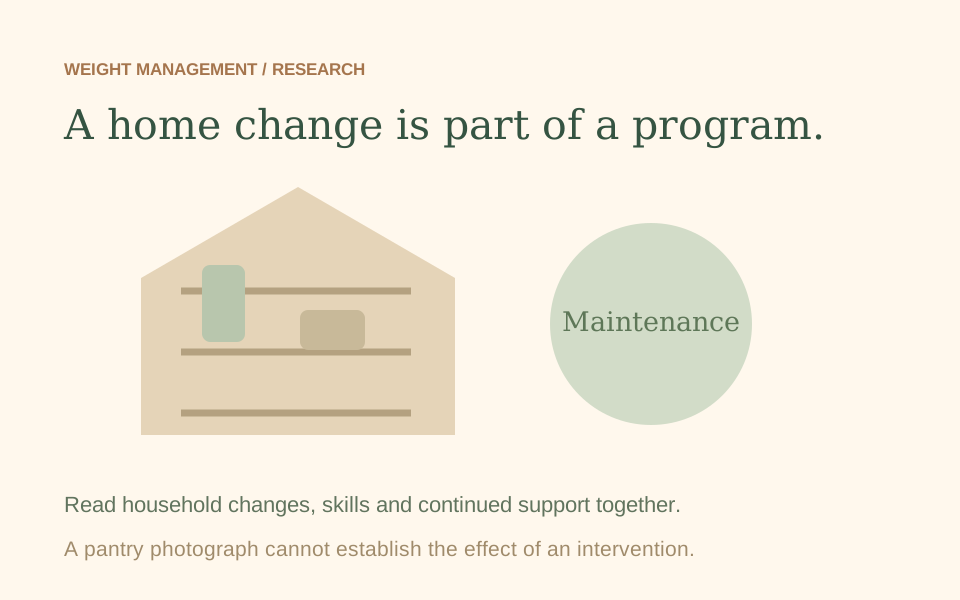
- Home-focused programs can change routines and support initial loss, but sustained weight effects are mixed. The whole intervention matters more than a pantry rule.
- Population, comparison and follow-up determine what the finding can establish.
- A study average is not an individualized outcome prediction.
The home is part of the routine
Shopping, food storage, cooking equipment and the people sharing a kitchen can influence how an eating plan works. Researchers have tested whether changing that environment adds value to behavioral weight treatment. The findings are more nuanced than the familiar advice to remove every tempting food. Some interventions improved early weight outcomes or aspects of eating behavior, while longer-term weight advantages were smaller, inconsistent or dependent on the analysis. The useful question is which practical support was tested and whether it produced a sustained effect. A home-focused program should not be reduced to a judgment about the moral quality of someone's pantry.[1] [2] [3]
For the related decision, read the connected evidence.
One trial added household support and equipment
Gorin and colleagues randomized 201 adults to behavioral weight loss alone or behavioral treatment plus changes to the physical and social home environment. The added program included items to support home routines and participation with a household partner. Both groups received continuing sessions. Weight loss favored the home-focused approach at six months, but the overall between-group difference was not statistically clear at 18 months, and regain rates were similar. That contrast between early and later findings belongs at the center of the story. An intervention can help initially without establishing a lasting general advantage.[1]
The added package cannot be reduced to one object
The home program combined a partner, materials and behavioral changes rather than assigning a single storage rule or portion plate in isolation. A favorable early result therefore does not prove that purchasing one item reproduces the package. Social support could interact with practical changes, and the effect of each part was not separately randomized. That limitation also applies to a commercial service borrowing the trial's language. Ask what it actually provides and which element its claim concerns. The study supports evaluating a structured home-focused approach, not attributing the entire response to a product that happens to appear in the intervention description.[1]
Subgroup differences are a reason for caution
The Gorin report described different treatment responses among women and men, with the home-focused approach benefiting women more clearly in its subgroup analysis. The sample was predominantly women, and the men's pattern differed. These findings are scientifically interesting but should not become a firm rule that every woman needs a partner-based program or that men should avoid one. Subgroup analyses involve smaller samples and need context and further study. The overall long-term result remains important. A household's preferences, privacy and relationship dynamics deserve individual attention rather than being decided from a broad gender label.[1]
For the related decision, read our support-model comparison.
A separate nutrition-focused trial followed people longer
Another randomized trial assigned 262 adults to behavior therapy, behavior therapy plus meal replacements or a nutrition-focused home food environment intervention. It followed weight outcomes through 36 months. All groups lost weight during treatment and regained some afterward. The home-environment group showed a modestly stronger long-term weight trajectory than behavior therapy in the reported analysis. That is complementary evidence for a different package, not a direct replication of Gorin's partner-and-equipment program. The investigators also examined cognitive restraint as a possible mediator. A secondary statistical mediation result should not be mistaken for a separately randomized test of that psychological pathway.[2]
Portion behavior and body weight were not identical results
PortionControl@HOME studied 278 adults with overweight or obesity. The multicomponent intervention targeted awareness, cooking skills, portion behavior and the home setting. Reported portion-control behavior improved at three, six and twelve months. The BMI effect, however, was statistically clear only at three months and only when three outliers were excluded. That qualified result should not be summarized as proven durable weight loss. The experiment is useful because it shows how a program can change a self-reported behavior more consistently than it changes body weight. The outcome named in a claim needs to match the outcome supported by the analysis.[3]
A home intervention is not a universally tidy kitchen
The trials do not establish that every household should follow the same arrangement or buy special equipment. A shared home may include different dietary needs, limited storage, cultural food traditions and budgets that make certain suggestions impractical. A workable intervention has to respect those constraints. An editorial application might be agreeing who handles the grocery list or making a routinely used ingredient easier to find. That is different from claiming the trial proved a particular shelf arrangement causes weight loss. Practical changes can be worthwhile because they reduce effort, even when their independent weight effect has not been measured.
For the related decision, read our Paprika review.
Shared decisions matter more than food policing
Including a household partner can add support, but it should not be assumed to authorize monitoring another person's portions or removing foods without agreement. The study design tested participation within a consented program, not coercive control of a kitchen. For a consumer, ask whether everyone affected understands the plan and whether it makes ordinary meals easier. If the household has conflicting needs, individual professional advice may be more useful than imposing a universal set of pantry rules. The goal is a manageable environment, not an inspection standard that turns occasional convenience food into evidence of personal failure.
What to ask a home-focused program
Ask which tasks the program changes, what materials it supplies, whether it requires a partner and how progress will be assessed over time. Clarify whether its evidence concerns behavior, weight or maintenance after support ends. A meal planner may organize shopping without providing behavioral therapy; a dietitian may tailor advice without delivering equipment. Neither is automatically equivalent to a research package. Compare the service with the actual difficulty in the routine. A program that addresses a concrete obstacle transparently may be more useful than one promising that a complete home overhaul is necessary for everyone.
The conclusion worth keeping
Randomized home-focused interventions show that the environment can be changed and that some packages can support weight management. The evidence does not establish a universal pantry formula or consistently large long-term effects. Early benefits, subgroup findings, behavioral outcomes and analysis-dependent BMI results need to remain distinct. Use the research to ask how a routine can be made more workable, with household agreement and appropriate support. The useful purchase is help with a real task that can be sustained. A better-organized kitchen can matter without becoming a guaranteed treatment or a measure of anyone's character.[1] [2] [3]
For a separate service and purchase assessment, read Plan to Eat review.
Sources
- Gorin et al. Comprehensive home environment randomized weight-loss trial (2013) (opens in a new tab)
- Investigators. Meal replacements and home food environment randomized trial with 36-month follow-up (2018) (opens in a new tab)
- Poelman et al. PortionControl@HOME randomized trial (2015) (opens in a new tab)
Research describes groups and specific study conditions. Your medical history, symptoms and treatment decisions require advice from your own qualified clinician.